CHAPTER FOUR
The Distance Home
Luna woke before the alarm and lay quietly beneath the thin blanket, trying to remember the last thing she’d thought about before falling asleep.
She knew perfectly well what it was.
Saturday night had been extraordinary. The gown, the borrowed sapphires, the music and the people who’d spoken to her about her writing. Her cousin’s quiet pride. Michael looking at her as she approached the ballroom, taking a little longer than usual to find his words.
And the kiss.
She smiled into the pillow.
It had been a gentle kiss. Not dramatic. Not like the kind a director might insist on filming three times from different angles while a violin section tried to convince an audience that two people’s lives had changed forever.
There had been no violins in the elevator lobby. Only the faint hum of the building and an arriving elevator whose timing had been spectacularly inconvenient.
She was rather glad of that.
When she looked at her phone, it was a few minutes past six. She had no messages from Michael. That was hardly surprising, considering they had never exchanged telephone numbers. Three days of talking, a flight to Jeju, a formal dinner, and a kiss, and neither of them had taken care of the most obvious practical detail.
If she’d written that into a drama, the senior writer would have marked it with a red pen.
Unbelievable. Give them a reason not to exchange numbers.
Luna turned the phone face down.
Outside the window, the eastern sky was pale. The gardens were still quiet, and the ocean lay beyond them, almost invisible beneath a thin bank of morning cloud.
She had hours before her flight. Michael had considerably fewer.
Thinking about the distinction made her want to stay in bed, which was an excellent reason to get out of it.
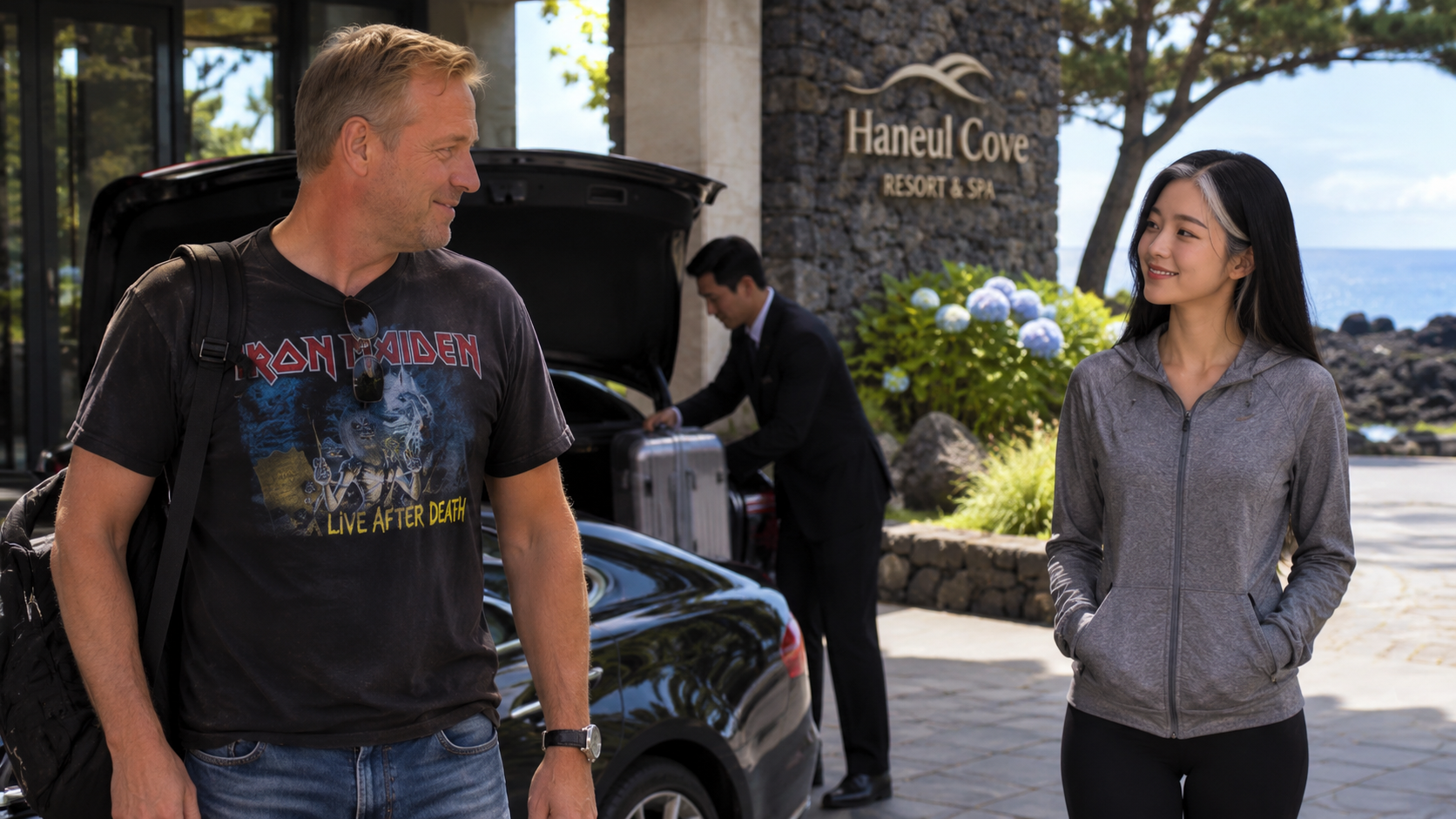
She pulled on black leggings, an old gray running sweatshirt and shoes that had spent more time inside her closet than on actual running paths. Her hair went into a loose knot. The silver-white streak fell out at once, followed by several smaller strands that refused to cooperate.
She looked in the mirror.
Good enough. She was going outside to exercise, not attend another gala.
She slipped her room key into her pocket and went downstairs.
The lobby had barely begun its day. Overnight staff were finishing their shifts, a florist was rearranging white blooms near the entrance, and a young employee was polishing fingerprints from the glass doors with the determined patience of someone who knew they would reappear in another five minutes.
Luna greeted the receptionist in Korean and went out through the garden entrance.
The air was cool and damp. It smelled faintly of wet grass, salt, and the sea beyond the volcanic stone walls. Tiny lights beneath the trees were switching off as the sky brightened. The terrace that had been filled with formally dressed guests the previous evening was empty again, its tables cleared and most of the temporary decorations already removed.
Someone had taken away the stage.
She wondered whether Ji-hoon had slept at all.
Luna started at an easy pace along the lower path, past the dark stone wall and the carefully pruned shrubs, then toward a turn where the sea opened between two stands of wind-shaped trees.
She knew the route. A little more than a mile if she followed the short loop, nearly three if she went all the way down toward the overlook and came back by the gardens.
This morning she chose the longer one.
At first she thought about nothing except her breathing and the irregular sound of her shoes against the path. Her legs were stiff from dancing only a little at the gala and standing for hours in heels. She liked that. It was something uncomplicated to pay attention to.
Then the previous evening began returning in small pieces.
Michael’s expression when the investors complimented his work. The way he had allowed her to steer conversations without pretending he understood things he didn’t. His helpless laughter when she explained how she’d translated his thoughts about Korean food into remarks fit for international diplomacy.
And the kiss.
That part returned without asking permission.
She slowed beneath a tree, smiling at the path.
He had moved toward her slowly. She had met him halfway. That detail mattered to her, although she wasn’t yet ready to examine why.
She started running again.
Near the far overlook, a groundskeeper bowed and wished her a good morning. She returned the greeting, breathing too hard for a proper conversation. Beyond him the ocean spread out under the growing daylight. A few small fishing boats moved in the distance. White water appeared and vanished along the black rock.
It was beautiful.
She was going to miss the place.
She was going to miss someone else much more.
That last thought arrived so clearly she almost stopped.
She had known Michael for only a handful of days. She knew his work, a little about the house where he lived, his peculiar relationship with expensive hospitality, and an alarming number of jokes that sounded as though they’d been invented by a man who’d spent too much time alone in airports.
She did not know what he wanted from life next year. She did not know whether he’d return to Korea. She didn’t even know his telephone number.
And somehow she wanted to hear him say something ridiculous over breakfast tomorrow, and the day after that.
Luna considered this while running past a low stone wall.
That was not particularly sensible.
But neither was a man who could tell an aircraft where it was and couldn’t reliably pronounce his lunch.
She laughed, then had to slow down because laughing and running uphill turned out to be a poor combination.
By the time she returned to the resort, her cheeks were flushed, the back of her sweatshirt was damp, and most of her hair had escaped whatever arrangement she’d attempted before leaving her room.
She looked at the time.
Breakfast was open. She was hungry. Coffee and a little food, then upstairs for a shower. She could change into something presentable before she saw Michael, assuming she saw him at all before he left.
It seemed a reasonable plan.
She entered through the side doors and followed the smell of fresh coffee toward the breakfast room.
Michael was seated beside the windows.
She recognized him before he looked up. The old Levi’s 501 jeans were unmistakable, and he wore the familiar black Iron Maiden Live After Death T-shirt, its worn fabric looking entirely at home with the jeans. His coffee stood beside a plate of eggs and toast, and his small travel bag was on the floor near his chair.
He looked comfortable. Completely unhurried.
Then he raised his eyes and saw her.
His expression brightened.
Luna stopped.
For one awful second she was aware of every detail she had failed to consider that morning. The sweatshirt. The leggings. The damp hair clinging near her temple. The heat still in her face. Even the running shoes, which she’d bought because they were practical and not because they were attractive.
Thursday’s white blouse had been chosen for the Diamond Penthouse. Friday’s K-Pop Demon Hunters shirt had been casual only after she’d spent twenty minutes making it look that way. Saturday had required an entire team of talented people and a gown she couldn’t have afforded herself.
This morning she’d looked in the mirror for approximately four seconds.
And here he was.
“I was going to shower,” she said by way of greeting.
Michael blinked once, then smiled.
“Good morning to you, too.”
She glanced at her sweatshirt.
“I went running.”
“I gathered.”
“I wasn’t expecting to see you.”
“Well, that’s becoming painfully obvious.”
Luna tried not to smile.
He stood and pulled out the chair opposite his.
“Have some breakfast?”
She looked toward the door, considering whether she could still escape upstairs.
Michael waited.
Then she sat.
“I look like I ran two miles around the grounds.”
“You did, didn’t you?”
“Yes.”
“Then I’d say you’re getting your money’s worth out of the outfit.”
She laughed despite herself.
He sat again and pushed the small basket of bread toward her.
The detail that surprised him wasn’t that Luna looked beautiful. He’d had three days to establish that. It was how entirely real she looked, sitting down without the slightest preparation, rubbing one cold hand against the other while she studied the coffee service. She had the color of exertion in her cheeks and a stubborn strand of silver hair sticking to her face. There was nothing for him to interpret and nothing she was trying to sell.
She was simply Luna, hungry after a run.
He found her adorable.
He also knew enough not to tell her that while she was busy being embarrassed.
A server arrived. Luna ordered coffee and rice porridge with fruit. Michael requested another coffee and assured the woman he already had enough toast to survive until Tuesday.
When the server left, Luna glanced at his plate.
“You have three pieces of bread.”
“Four. One’s hiding under the eggs.”
“Why?”
“Security. You never know when breakfast is going to turn on you.”
She shook her head and picked up the small plate of fruit he’d moved toward her.
She reached for a strawberry, leaned forward to hear something he said about the buffet, and laughed with her whole face rather than the polite smile she used at work.
Michael watched her, pleased.
“Did you sleep?” she asked.
“A little.”
“Only a little?”
“Long party.”
“Yes.”
They exchanged a look.
Neither mentioned the elevator lobby.
Neither needed to.
Outside, the morning sun reached the lawn. A few guests crossed the terrace with jackets over their arms. Staff moved between tables, filling cups and clearing plates.
Luna wished, just for a moment, that ordinary schedules could be negotiated.
Michael checked his watch, then set it facedown beside his plate.
“The car’s coming soon,” he said.
“How soon?”
“Enough that I probably shouldn’t get another plate of eggs.”
“That is very serious.”
“Extremely.”
She smiled, but her eyes moved toward the travel bag at his feet.
“My flight is later,” she said. “I still have time.”
“Lucky you.”
“Economy. Perhaps not so lucky.”
He grinned.
“Don’t let the airline hear you. They’ll try to send another plane.”
She laughed, then looked down into her coffee.
He was leaving Jeju first. She would follow a few hours later. Tonight they would both be in Seoul, but early Monday he would be crossing the Pacific.
“Will you come back?” she asked.
She had intended the question to sound casual. It didn’t quite manage it.
Michael didn’t pretend to know.
“Maybe. Depends on the job. The airline may have another phase, and if they do, I could be back sooner than I expect. But there’s nothing scheduled.”
She nodded.
“I understand.”
“I’d like to, though.”
She raised her eyes.
He smiled a little.
“It’s been a pretty good trip.”
“Very good,” she agreed.
They held each other’s gaze for a moment.
Michael could have said more. He didn’t. She was looking at him as though she already understood.
He took another sip.
“So. Your story.”
Luna brightened a little.
“Still alive.”
“That’s a promising start.”
“I wrote yesterday. I have more ideas.”
“Good. Don’t let some obnoxious American distract you.”
She lifted an eyebrow.
“I think that already happened.”
Michael smiled.
He was about to answer when Ji-hoon approached.
He wore a dark suit and carried a slim folder. His professional expression was in place until he noticed his cousin sitting across from the airline’s important guest, apparently dressed for a gym she had just escaped from.
He looked at her running shoes.
Then at her sweatshirt.
Then at Michael.
Luna recognized the sequence immediately.
“Good morning, oppa,” she said, before he could begin.
Ji-hoon stopped beside the table.
“Da-eun,” he said in Korean, with exquisite restraint, “you never cease to surprise me.”
The sarcasm was so polished that anyone without a lifetime of experience dealing with him might have mistaken it for a compliment.
Michael didn’t understand the words, but he understood the tone.
Luna closed her eyes briefly.
“I went running.”
“Indeed. I can see that.”
Michael made a small noise behind his coffee cup.
Luna turned toward him.
“Don’t.”
“I didn’t say anything.”
“You were thinking it.”
“Very unlikely. I don’t do much thinking before nine.”
Ji-hoon watched them for half a second longer than necessary, then recovered his professional manner.
“Mr. Michael. Good morning.”
Michael stood at once, his phone still in one hand. Without thinking, he passed it to Luna to free his hand, and shook Ji-hoon’s.
“Morning, Mr. Kang. Thank you again for last night. You and your staff put on a wonderful evening.”
“The pleasure was ours. We were honored to have you attend.”
As Ji-hoon spoke, the concierge arrived with a polite bow, followed by a bell attendant who’d come to collect Michael’s bag.
“Mr. Michael, your car is waiting at the main entrance. We can take your bag now, and your driver will escort you directly to the business aviation facility.”
“Perfect. Thank you.”
The staff member collected the bag and stepped back, waiting for the conversation to finish.
Luna sat holding Michael’s unlocked phone.
He’d handed it to her without a thought. He had no reason to assume she’d do anything but hold it for him.
She looked at the screen.
For a moment she was just surprised by the simple trust in the gesture. Then she saw the Contacts icon near the bottom.
She hadn’t intended to do anything. She’d spent breakfast making a careful effort not to ask him for promises, addresses, numbers, or anything that might become a disappointment later.
Now the phone was in her hand.
Her thumb moved before she could talk herself out of it.
Contacts. New contact. The labels were in English. She read English every day, but some of the little commands were different from the ones on her own Korean-language phone. For an absurd instant she couldn’t remember whether the button for adding a note was under More Fields or somewhere else entirely.
She found it.
Na Da-eun.
Her Korean mobile number.
Then, on a separate third line, she entered:
(Luna) ❤️
Her heart was beating much too quickly for a woman who was merely using a telephone.
She saved the entry. Hesitated. Then called her own number just long enough for the missed call to appear on her phone, silent in her sweatshirt pocket. It would leave her his number, too. She ended the call and returned the screen to the way he’d left it.
The whole thing was a small rush of fingers and half-understood labels, finished while Ji-hoon was explaining the arrangements and Michael was insisting he didn’t need any special treatment.
She couldn’t have said why she’d done it.
She had never done anything like it before.
Part of her was astonished. Another part, one that had spent years keeping expectations carefully folded away, was almost delighted.
She had stepped off the edge of something without knowing how far it went.
Michael turned back toward her.
“Thanks, Luna.”
She handed him the phone.
“Of course.”
He slid it into his pocket and turned to thank the concierge.
He hadn’t noticed a thing.
The bell attendant moved toward the entrance with the bag. Michael looked at his watch and gave a quiet sigh.
“Looks like that’s me.”
Ji-hoon bowed.
“Safe travels, Mr. Michael. Please accept our thanks again, and we hope to welcome you back.”
Michael bowed in return, not perfectly but with genuine respect.
“You’ve been wonderful, Mr. Kang. Tell your team how much I appreciated everything. Especially the people who handled the gala.”
“I will. Thank you.”
Ji-hoon looked toward Luna, then returned his attention to the concierge.
Michael faced her across the small distance between the table and the aisle.
Around them were the general manager, the concierge, servers, and other guests. Luna was the writer and translator who’d accompanied the airline’s visiting engineer. That was how they’d been introduced. It was all anyone here had reason to know.
He couldn’t draw her into an embrace without changing that understanding. He wasn’t going to put her in that position.
So he gave her a small, sincere bow.
“Thank you for everything, Luna. The help, the translations, the company.”
She stood and returned the bow.
“It was my pleasure, Michael.”
Their eyes met.
Neither smiled very much. Neither looked away immediately.
Then a staff member moved toward the doors, and the moment was over.
Michael followed the concierge through the lobby toward the waiting sedan. The driver was standing beside the open rear door. Michael thanked him, then paused as the attendant placed the bag in the trunk.
He looked back through the glass.
Luna stood near the entrance to the breakfast room, still in her gray sweatshirt, one hand hanging loosely at her side.
She had been watching him.
For one suspended second, their eyes met across the lobby.
He lifted his chin just slightly. She answered with the smallest movement of her head.
Then he got into the car.
The door closed. The driver moved around to his seat, and the sedan rolled away from the covered entrance.
Michael looked back as the building slid past the window. The lobby was visible through the glass for a moment, and there was Luna, small against the pale stone and the morning light.
Then the driveway curved past trees and volcanic rock, and she was gone.
Luna watched the car disappear behind the landscaped wall.
She remained where she was until a different vehicle pulled beneath the entrance and a family began unloading beach bags.
The resort went on with its morning.
Of course it did.
She touched her sweatshirt pocket. Her phone was still there. She could feel its familiar shape through the fabric.
She had his number.
He had hers, although he didn’t know it.
She wasn’t sure whether she was proud of herself or slightly horrified.
Both seemed possible.
Then she looked at the driveway once more and went upstairs to shower and finish packing.
Her room held the scattered evidence of a weekend that had briefly felt outside ordinary life. Running shoes beside the door. Her laptop open on the desk. The garment bag containing the gown, already returned to the resort. A single hairpin Yuna had overlooked on the vanity.
She set the hairpin beside the mirror, where housekeeping would find it, and began folding her clothes.
The act was familiar. Clothes, charger, notebooks, room key. The small things she was supposed to think about before a flight.
Her thoughts kept drifting back to the lobby.
The bow.
The last look.
The way his departure hadn’t waited for either of them to be ready.
A little later she stopped by Ji-hoon’s office. He was reviewing a schedule and looked up as she entered.
“He’s gone?” he asked.
“Yes.”
Ji-hoon looked at her face, then at the folded running sweatshirt she was carrying in her bag.
“You enjoyed yourself this weekend.”
It wasn’t quite a question.
“Yes,” she said.
He nodded and didn’t press.
“Mrs. Park left her card for you. She asked whether you might be interested in discussing some writing work in Seoul.”
Luna looked surprised. She accepted the card from him and read the name.
“Really?”
“Really. I told her to contact you directly. I don’t negotiate my cousin’s professional life for her.”
She smiled.
“Thank you, oppa.”
“It’s your work.”
She put the card carefully into her bag.
“Thank you for the room. And the dress. And the gala.”
He waved one hand.
“Family.”
She stepped around the desk and hugged him, which startled him for a moment before he returned it.
“Come back soon,” he said.
“I will.”
“And please don’t leave with the sapphires.”
She laughed against his shoulder.
“They’re already back where they belong.”
“Good. I was trying to decide whether I should deduct them from your allowance.”
“You don’t give me an allowance.”
“Exactly. A difficult accounting problem.”
She released him, still smiling.
He looked at her for a moment. Whatever he had noticed at breakfast, he left unspoken.
“Safe flight, Da-eun.”
“Thank you, oppa.”
She turned toward the door.
Outside, a resort shuttle was waiting for guests traveling to the airport. She joined them, put her small bag overhead, and took a window seat.
As they drove away, she looked back toward the main entrance.
There was no black sedan now.
The long curve of the driveway was empty.
Michael’s ride to Jeju Airport took him past stone walls, small farms, and stretches of road lined with low buildings. He watched the landscape through the window without paying much attention to it.
The driver asked whether he had enjoyed the resort.
“Very much,” Michael said.
The answer was easy enough.
He was less certain what to do with the fact that he had enjoyed someone at the resort more than the resort itself.
The car turned toward the business aviation facilities. Michael thanked the driver, collected his bag, and followed an airline representative inside. There were identification checks, a brief conversation about the timing of the return flight, and an offer of more coffee.
He accepted the coffee.
He’d become remarkably good at accepting things during this trip.
The aircraft waiting on the apron was another Gulfstream. He had flown several models over the years and recognized the familiar lines with the automatic appreciation of someone who’d spent much of his professional life around aircraft.
The first officer greeted him at the foot of the steps.
“Mr. Michael. Good to see you again.”
“Good to see you. How’s everybody?”
“Very well. Captain Lee is aboard.”
Michael smiled.
“Then I suppose I’m in good hands.”
The first officer laughed, evidently pleased.
Inside, Michael put his bag in the cabin and stepped forward to greet the pilots. Captain Lee shook his hand warmly.
“We received the observations you sent on Friday.”
“Good. Wasn’t anything urgent.”
“We know. Engineering reviewed them yesterday. They are incorporating the first adjustment into the next configuration update.”
“Excellent.”
“And the second has been approved for further testing.”
“That’s all I wanted. Nobody needs to start tearing apart perfectly good equipment because I found a couple milliseconds worth chasing.”
Lee smiled.
“Some engineers do not like to hear that the pilots have suggestions.”
“Some engineers don’t have to sit in the thing for twelve hours.”
The first officer laughed.
Michael looked at him.
“You’re the guys using it. If the display makes you work harder for no good reason, I want to know. Doesn’t matter how pretty it looked in the lab.”
Lee nodded, and for an instant Michael saw something beyond professional courtesy in the man’s expression. Appreciation, perhaps, at having been listened to.
“We were very glad you came into the cockpit,” Lee said. “Not only to inspect the installation.”
“Glad I did. You were easy to work with.”
The captain reached toward a small rectangular box on the side console, wrapped neatly in cream paper and tied with a dark ribbon.
“We have a small gift for you. From the crew.”
Michael looked at it.
“You don’t have to give me anything.”
“We know.”
“Then you’ve noticed I say that a lot.”
The first officer smiled.
“Perhaps.”
Michael accepted the box with both hands, as he had learned to do when receiving something formally in Korea. Inside was a handsome bottle of traditional Korean soju, accompanied by two small cups. The bottle was elegantly shaped, the label restrained and beautifully printed.
It wasn’t the sort of extravagant gift he’d received at corporate ceremonies. That made him like it more.
“That’s very thoughtful,” he said. “Thank you.”
Lee looked pleased.
“A small reminder of Jeju.”
Michael ran his thumb across the edge of the box.
He remembered Luna raising a glass of soju on their first evening and teaching him to say geonbae.
“It’s perfect,” he said.
They completed their greetings and prepared to depart. Michael took a seat in the cabin. He didn’t ask to return to the cockpit. The observations were documented, the crew had a job to do, and there was nothing to gain by hovering over people doing it well.
The flight was comfortable, short, and thoroughly ordinary.
A manager traveling on the aircraft asked about the system, and Michael gave an accurate account of the follow-up items. He answered several questions about the installation, accepted more coffee, and briefly discussed the possibility of future work.
Between questions, he looked out the window.
Jeju receded beneath a thin layer of cloud.
He kept picturing Luna in her gray sweatshirt, still flushed from running, watching him through the resort’s glass doors.
He smiled faintly.
At some point during the descent, the manager asked him a question about a new display module.
Michael turned toward him and answered, explaining the display specifications from memory.
After landing, another car took him to the Grand Hyatt Seoul.
His room was waiting. So was the larger suitcase he’d left in the hotel’s care before traveling to Jeju.
Michael thanked the bell attendant and closed the door.
He set the little box of soju on the desk beside his passport, then packed it carefully between two folded sweaters in his checked suitcase.
A few minutes later he was back in the familiar business of going home. The hotel had been told when to send the car. A representative of the airline had confirmed the early departure. A message from his company asked whether he could join a meeting on Tuesday. He agreed, provided his head and the time zones were speaking to one another by then.
He paid attention to the details. It was the practical part of travel he had long since learned to respect. A misplaced passport, a charger left behind, or a wrong departure time could make a perfectly ordinary journey miserable.
He checked each item once and put it where it belonged.
The room was familiar, comfortable, and suddenly less interesting than it had seemed three days earlier.
He put the suitcase on the bed and began sorting his clothes.
Business shirts into one side.
Casual clothes into the other.
Chargers, adapters, documents, and the small collection of items he’d accumulated during the assignment went into the appropriate pockets.
He was efficient at packing.
He’d done it hundreds of times.
He took off the Iron Maiden shirt he’d worn at breakfast, folded it, and smiled as he put it into the suitcase.
Then he remembered Luna examining the words Live After Death with the utmost seriousness.
“How can you be alive after death?”
He laughed to himself.
A man could finish a multimillion-dollar technical installation without difficulty, yet he’d been thoroughly defeated by a woman reading an album cover.
He folded the shirt and put it away.
By late afternoon, everything was ready except the few things he’d need before leaving at dawn.
The hotel confirmed a car for the morning.
The airline confirmed his arrival time at its private aviation facility.
He reviewed the details and set an alarm.
Then he went to the window.
Seoul stretched beneath him, immense and busy in the fading light.
Somewhere in that city was the Diamond Penthouse.
Somewhere nearby was Luna’s apartment.
She was probably still traveling.
He wondered whether she’d found a decent cup of coffee at the airport.
He wondered whether she was writing.
Then he wondered whether he was going to spend the rest of the evening wondering about her.
He had a fairly good idea of the answer.
Luna’s afternoon flight was delayed twenty minutes.
She had plenty of time to get through the airport, which was the only generous feature of the arrangement. She’d bought an inexpensive ticket weeks earlier, chosen not to pay for a better seat, and arrived with a small carry-on that fit within the airline’s strictest interpretation of the word small.
At the gate, families settled around paper cups of coffee and shopping bags. A young couple sat together with their heads bent toward the same phone. Two elderly women compared photographs, each apparently determined to prove her grandchildren were more photogenic than the other’s.
Luna found a seat near a window.
A few hours ago she’d been sitting across from Michael at breakfast, trying to hide the fact that she’d just run around the grounds and been caught completely unprepared.
Now she was another passenger waiting for an ordinary flight.
She didn’t mind economy. She didn’t particularly care how the airline treated Michael, beyond being pleased that someone appreciated his work. His world was larger and more expensive in certain ways, but hers was the one she knew and had chosen for herself.
She wasn’t going to spend the afternoon pretending she wished she were on his airplane.
She was going to write.
Her laptop emerged from the bag. She opened Untitled 17 and found the scene she’d been working on Friday morning, when the characters were still so new she wasn’t sure what to call them.
The man repaired complicated antique clocks. The woman translated old letters and documents. They had met because of a misunderstanding in a hotel where nothing kept proper time.
She read the dialogue.
The problem became obvious immediately.
Her American sounded too neat.
He said what he meant, then explained why he’d said it. He used perfectly sensible sentences that any English teacher would have approved, and he almost never made the woman laugh.
Michael was not like that.
Michael could answer a serious question with something absurd, wait for her to protest, and somehow arrive at the serious answer while she was still laughing.
She opened a note at the bottom of the document.
American dialogue. Less correct. More Michael.
She looked at the sentence she’d just typed and laughed softly.
Less correct was not exactly a professional instruction.
She tried writing a new exchange in which the fictional man protested when the woman suggested he should stop working.
“Hold your horses there, cowgirl.”
Luna read it once.
Then twice.
She frowned.
Why would a man in a hotel call a professional translator a cowgirl? She had seen the expression in an American movie, but she wasn’t certain whether it belonged in Texas, the nineteenth century, or a conversation about actual horses.
She imagined Michael reading it.
He’d raise an eyebrow, perhaps look out the window as though searching for livestock, and ask what sort of operation she thought he was running.
She laughed.
An elderly man sitting a few seats away looked up from his newspaper. Luna lowered her eyes toward the screen.
She tried again.
“Back up there, missus. Did I really order another one of those soju drinks?”
That was closer to the voice she remembered. Or perhaps it was further away. She couldn’t decide.
She could practically hear him saying, with exaggerated patience, that a man who’d spent three weeks in Korea ought at least to know that soju was already a drink, and that calling it a soju drink was like ordering a beer beverage.
Then he’d probably insist that beer beverage was an excellent expression and demand to know why nobody used it.
She smiled so broadly that the woman beside the gate window smiled back, apparently assuming there was something cheerful on Luna’s screen.
Luna stopped trying to imitate the exact phrasing.
Perhaps that was the wrong way to approach it. She didn’t need to make her character sound like a recording of Michael. She needed to write the experience of listening to someone whose mind moved at an unexpected angle.
She wrote another exchange. The man was asked whether he’d enjoyed the evening. He said he’d survived the food, the speeches, and something called diplomatic relations, and now expected to be awarded an honorary degree in smiling politely.
The woman had a response before Luna finished typing the question.
This time she laughed because the characters sounded alive.
The boarding announcement interrupted her.
She saved the work and joined the line.
The aircraft was nearly full. Her seat was in the middle, between a man who immediately put on headphones and a woman holding a small shopping bag. The overhead compartment was crowded. Somebody had left a jacket stretched across two spaces, and she gently moved it aside to fit her carry-on.
The air in the cabin was warm, smelling faintly of coffee and the perfumes passengers had applied before boarding. A child farther forward wanted to know why airplanes could fly. His father was giving an explanation involving wings, wind, and an alarming number of hand gestures.
Michael could have explained it better.
She smiled at the thought, then wondered whether he’d have deliberately made the answer worse first.
The flight pushed back from the gate. Luna fastened her belt, put the laptop away for takeoff, and watched the runway slide past the small window beyond her neighbor’s shoulder.
Jeju rose and fell beyond the aircraft as they climbed. Dark coastline, green interior, a mountain disappearing into cloud.
She’d left places she loved before. Usually it meant going back to her apartment, getting some laundry done, and returning to the unfinished work that had waited while she was away.
This time it felt like leaving a conversation in the middle of a sentence.
She glanced at her phone.
There was a missed call in her recent history. She knew where it had come from, even though the number was unfamiliar. She’d done something bold that morning and hadn’t yet decided whether it had been courageous or ridiculous.
She saved the number without a name at first. Then she typed Michael and stared at the letters for a moment.
She did not send a message.
She could have. She knew that. The fact made her feel strangely exposed, as though she were holding open a door she’d spent years keeping closed.
When the seat-belt sign went off, she reopened the laptop.
She worked on the script while the cabin around her settled into the small noises of domestic air travel. The woman beside her opened a novel. The man on her other side slept almost immediately. A flight attendant came through with drinks, and Luna accepted water without looking away from a line she was trying to repair.
The man’s dialogue still needed work, but the woman was becoming clearer. She was competent and funny and knew exactly how to handle the things other people expected of her. What she didn’t know was how to respond when someone treated her competence as interesting rather than useful.
Luna stared at that sentence.
Then she began rewriting the scene around it.
By the time the aircraft descended toward Gimpo, she had filled several pages with dialogue, notes, and ideas. Some were clumsy. Some would be deleted. But a few lines made her feel the familiar little rush that came when she knew a scene had found its voice.
She closed the laptop just before landing.
Only then did she notice that she hadn’t paid attention to the cramped seat, the delayed departure, or the fact that no one had offered her anything more elaborate than a paper cup of water.
She’d been someplace else entirely.
Somewhere a man could turn an argument about lunch into a conversation about jazz, and a woman could understand him without needing to translate every word.
Her apartment felt smaller than she remembered when she opened the door that evening.
She set her bag down, took off her shoes, and stood for a moment in the familiar quiet.
There was her writing desk beneath the window.
There were the books beside the television, the notes on the low cabinet, and the same half-finished assignment she’d been avoiding before leaving for Jeju.
Nothing had changed.
Except the person who’d come home.
She shook her head at the thought.
That was exactly the kind of sentence she would normally delete from a script for being too dramatic.
Nevertheless, it was difficult to argue with.
Luna opened the windows, unpacked, and put a load of laundry into the washing machine.
Then she made tea and sat at her desk.
Untitled 17 waited on the screen.
She read the first pages.
The man repairing clocks was clever, patient with difficult machines, and occasionally impatient with people who assumed the machine was the problem simply because they didn’t understand it. He was entirely too pleased with his own jokes.
She gave him one of Michael’s habits without thinking: when a conversation turned serious, he sometimes held his coffee cup in both hands and waited rather than rushing to fill the silence. She noticed it only after she’d written the gesture twice.
That was dangerous, she decided. Not the gesture itself, but how easily the real man was finding his way into a character who was supposed to be fictional.
She changed his profession again, then changed it back. She changed the city, the weather, and the reason the characters were in the same hotel. None of it altered the thing she was actually trying to capture.
Being seen by someone who hadn’t been looking for you.
The translator was observant, independent, and tired of people assuming that because she knew two languages, she existed to explain everything for everyone else.
Their first conversation wasn’t in a hostess lounge anymore.
She’d changed the setting to a fictional hotel whose clocks had all stopped at different times.
The man had been sent to repair them.
The woman was there to translate an old collection of letters left by a former owner.
They met because he couldn’t explain a technical problem and she misunderstood a phrase he used.
It was a small premise.
Perhaps a very good one.
Luna began writing.
She wrote the scene in which the two characters first met.
The woman was tired, having worked all day. The man had just arrived from another country and wanted coffee. He mistook a formal greeting for an invitation to sit, and she decided he was either very rude or very funny.
She wasn’t sure which.
That made the scene work.
She wrote their second conversation.
Then a third.
The words came quickly.
In the third scene, the translator attempted an American idiom she’d learned from an old film. The man answered with another, and she misinterpreted it so spectacularly that both characters had to stop what they were arguing about.
Luna sat back, laughing.
She could hear Michael’s voice. Not the exact words. The way he would respond, gently mocking her and making it perfectly clear that he was laughing with her rather than at her.
She tried an exchange about an imaginary meal that involved food no sensible person would order. She stopped before naming the sea urchin. That particular joke belonged to two real people, and she wasn’t ready to lend it to fictional ones yet.
Instead, she wrote a scene about a tea service in which the man couldn’t distinguish the salt from the sugar. The woman watched him make the mistake and allowed him to suffer the consequences of his own confidence.
It was funny.
It also belonged to the story, rather than being a transcript of a memory.
That distinction mattered to her.
She’d spent years taking someone else’s characters and finding ways to make their dialogue work. She could recognize the difference between copying an amusing remark and understanding why it was amusing. Now, with every new scene, she was getting better at the second.
She opened another document, one she used for the professional assignment waiting in Seoul, and typed a small note about the two sisters’ argument. Maybe she could improve that scene too. Maybe the younger sister didn’t need a grand confession. Maybe she needed one honest sentence and the courage to let the silence afterward do some of the work.
She smiled at the connection, saved the note, and went back to her own characters.
Not every line was good. She stopped often, erased a few sentences, moved dialogue from one character to another, and occasionally laughed at something she’d written.
But the scenes belonged together in a way her notes from Friday hadn’t.
She could hear the characters.
That was new.
Or rather, it was something she’d almost forgotten she could do.
Usually she began with a scene that existed because somebody needed it for a production. A character required a revelation. A director wanted a confrontation. An actress wanted a moment that would make audiences sympathetic.
This time, she wasn’t solving somebody else’s problem.
She was following two people to see what they would say next.
When she reached the scene where they had to part, she stopped.
The man was leaving by car.
The woman would remain behind.
Neither had a reason to ask the other to stay.
Luna looked at the blank space on the screen.
She could make the man run back.
She could make the woman stop the car.
She could give them an extraordinary declaration, an impossible flight cancellation, a dramatic promise made beneath the rain.
She’d written scenes like that for other people.
Some had worked beautifully.
But they didn’t belong here.
She wrote the woman standing outside the hotel while the car drove away.
The man turned to look back.
For one moment, they could still see each other.
Then the road curved.
Luna stopped typing.
Her eyes hurt a little.
She took off her glasses, rubbed them, and reached for her tea.
It had gone cold.
She looked at the clock.
Almost eleven.
The washing machine had finished long ago.
She’d forgotten dinner.
She’d also written more usable dialogue in one evening than she normally managed in several days.
She read the last two pages.
They weren’t perfect.
But they were alive.
For once, the feeling behind the words didn’t seem to be something she had manufactured to satisfy an assignment.
She knew it.
She closed the laptop without sending the file to anyone.
There would be time for opinions later.
Tonight, she wanted the story to remain hers.
Monday began before sunrise for Michael.
The car arrived outside the Grand Hyatt while Seoul was still mostly dark.
The concierge who’d helped him find the Diamond Penthouse three evenings earlier was not on duty, but another member of the staff carried his bags to the entrance and wished him a pleasant journey.
Michael thanked him and settled into the back seat.
As the car pulled away, he glanced toward the lobby doors.
He remembered walking out of them on Thursday evening, looking for a drink and someone interesting to talk to.
He’d found rather more than he’d expected.
At the airline’s private aviation facility, the formalities were handled quickly. An operations representative greeted him, confirmed his documents, and escorted him toward the waiting aircraft.
The Gulfstream was already being prepared for departure.
He knew its general systems well enough to appreciate the work being done around it, but he had no desire to inspect anything that morning.
He wanted coffee and a seat by a window.
A flight attendant showed him to the cabin.
A senior airline executive greeted him warmly.
“Mr. Michael. We are very pleased you could join us for the return flight.”
“Thank you. I appreciate the ride.”
“You were able to enjoy Jeju?”
“Very much.”
“The hotel was satisfactory?”
Michael smiled.
“More than satisfactory.”
The executive began describing the property, its reputation, and the airline’s relationship with its management.
Michael listened, nodded at the appropriate moments, and answered when necessary.
But his thoughts kept wandering toward a small breakfast table overlooking the ocean, where a woman in an oversized sweatshirt had asked him whether he’d slept well.
The aircraft taxied toward the runway.
As they climbed above Seoul, the executive continued speaking about possible future projects.
Michael caught enough of the conversation to recognize that the airline was considering another phase of development.
Under ordinary circumstances, that would have commanded his complete attention.
Instead, he found himself asking for the details to be sent by email.
“I’d like to take a proper look when I get home,” he said.
The executive nodded.
“Of course. We would be delighted to work with you again.”
“So would I.”
That answer, at least, required no effort.
He looked out the window.
The country slipped away beneath the aircraft.
A few hours later, the world below was nothing but water and cloud.
Michael opened his laptop, reviewed two routine messages, then closed it again.
He took out his phone and looked at one of the photographs he’d taken in the resort gardens on Saturday. The ocean was a beautiful blue, and the stone paths looked peaceful. He knew exactly where Luna had been standing when he’d shown her the view.
He hadn’t asked for her number.
It was an extraordinarily stupid oversight for a man who made a living ensuring that complicated systems could communicate with one another.
He smiled at the irony.
Then he put the phone away and tried to sleep.
In Seoul, Luna slept until nearly nine.
The sunlight was already reaching her window when she opened her eyes. For a moment she looked at the ceiling, vaguely surprised by the hour. She was usually awake much earlier, especially when she had something due.
Then she remembered the laptop.
She’d written until well past midnight, unable to leave the story alone even after promising herself she would stop. At some point she’d moved from her desk to the sofa with the computer balanced on her knees, then back again when she decided the scene needed more concentration than a sofa encouraged.
The kitchen held an unwashed cup. The washing machine had finished sometime during the night. Two pages of handwritten notes lay beneath her phone.
She was tired.
She also felt oddly happy.
Michael had been on his way to Seattle for more than an hour by now. She knew his departure was early, although she didn’t know the precise time his aircraft had taken off. Somewhere above the ocean, he was drinking airline coffee and talking to people who understood satellites much better than she did.
She wondered whether he was being polite and attentive or whether he was making a joke that nobody dared question because he was the important visiting engineer.
She smiled into her pillow.
Then she got up, made coffee, and opened the curtains.
Outside, Seoul was doing what Seoul always did. Buses stopped, pedestrians hurried, delivery vehicles crowded the street, and a neighbor on the opposite side of the courtyard was hanging laundry with an expression that suggested she would rather be doing anything else.
Luna watched for a moment.
A perfectly ordinary Monday.
Her script was still waiting on the desk.
She made one small change before showering. In a scene where the man tried to explain a difficult mechanical failure, she took out three sentences of explanation and replaced them with one question from the woman. Suddenly the scene worked.
She shook her head.
Of course it did. The woman had simply listened.
At the production office later that morning, the senior writer was discussing revisions to the sisters’ argument. The director still wanted somebody to cry. One of the actresses wanted a different line before the emotional turn, and the production manager was worried the scene would take longer to shoot than scheduled.
Luna took notes. She asked two practical questions and suggested a way to move the argument forward without making both sisters deliver speeches about feelings they’d already explained three times.
The senior writer considered her suggestion.
Then nodded.
“That could work.”
Ordinarily Luna would have been delighted to hear those words. She was pleased, and she went to work on the changes without hesitation. But she found herself thinking, just for an instant, how Michael would have reacted to the entire conversation.
Probably something about solving a problem by asking someone not to cry about it.
She pressed her lips together to keep from smiling during a serious production meeting.
By late afternoon, the revisions were finished and the pages sent to the people who needed them. She still had a few hours before the Diamond Penthouse shift, so she opened her own screenplay again.
It was strange how much she wanted to return to it.
She read a scene from Sunday and found that it was better than she’d remembered. Not perfect. Several lines needed trimming and one joke had apparently been written by a person suffering from a temporary loss of judgment.
But the two characters sounded like people she wanted to spend time with.
She saved the changes, packed her laptop, and went to work.
At the Diamond Penthouse, Min-ji was waiting near the service corridor.
“Luna. Back from Jeju.”
“Yes.”
“Did you enjoy yourself?”
“Very much.”
Min-ji studied her.
“You look happy.”
“Is that bad for business?”
“It depends. Sometimes happy people are terribly difficult to persuade to work.”
Luna smiled and put her bag away.
Min-ji leaned closer.
“You remember the American from the Grand Hyatt.”
Luna looked at her.
It was such a peculiar way to describe Michael after the last few days that for a second she almost laughed.
“Yes. I remember him.”
“He was a wonderful customer. Very generous. And he stayed a long time because he enjoyed speaking with you.”
Luna understood where the conversation was going.
Min-ji smiled with the confidence of a woman who believed she had discovered an exceptionally reliable business strategy.
“We have two Americans tonight. Traveling together. Both seem to have money. I thought perhaps you could work your magic again.”
Luna looked amused.
“Magic?”
“English. Conversation. Good manners. Whatever you did last time.”
She almost answered that what she’d done last time was very little. Michael had done most of the interesting part simply by being himself.
Instead she nodded.
“I’ll take good care of them.”
“Of course you will.”
Min-ji gave her a small, approving pat on the arm and turned to deal with a server who had brought the wrong bottle to the wrong table.
Luna straightened her blouse, checked her hair in the narrow mirror near the corridor, and went out into the lounge.
The two Americans were seated near the windows, in a booth much like the one where she’d first met Michael. One wore a navy jacket without a tie. The other had loosened his collar and was looking through the drinks list as though he suspected the prices might change if he turned the page again.
They stood when she approached.
“Good evening,” she said warmly. “My name is Luna. May I join you?”
They welcomed her with easy smiles. They were friendly, well dressed, and plainly pleased to have a hostess who spoke English.
One asked whether she lived in Seoul. The other wanted recommendations for Korean food. They explained that they were visiting for business and had been told the Diamond Penthouse was a good place for drinks and conversation.
Luna listened, answered, and helped them choose a bottle.
They weren’t unpleasant men. They had no reason to be. They told stories about delayed flights and expensive hotels, complained harmlessly about the amount of paperwork their company required, and asked questions she’d answered many times before.
Luna kept the conversation moving, giving each man room to talk and guiding them gently back to drinks and food.
A plate of appetizers arrived. The man in the navy jacket examined one dish and made a joke about being uncertain whether it was food or something he’d found at the bottom of the ocean.
Luna smiled.
And suddenly she remembered Michael claiming he might accidentally order raw sea urchin in a smelly sock, then suggesting a Korean waiter would be polite enough to find both items rather than question the order.
Her smile widened before she could stop it.
One of the Americans noticed.
“Did I get it right?”
She looked at him.
“Yes,” she said. “It was funny.”
She asked him about his visit, and the conversation moved on.
After a while the second man asked whether another Korean hostess might join them. Min-ji had mentioned that possibility earlier, and Luna signaled discreetly toward the service area.
A young woman approached, bowed, and sat beside him. Most of her conversation was in Korean. The Americans seemed delighted by the challenge and began attempting simple phrases.
Luna translated when necessary and let the conversation move around her.
She was grateful for the diversion.
One of the Americans raised his glass and attempted a Korean toast. The pronunciation was dreadful. The second hostess corrected him, laughing, and he tried again.
She refilled glasses, helped order food, answered questions, and made sure the guests were comfortable. At the end of the evening the men thanked her warmly. One complimented her English. The other said he’d enjoyed learning a little Korean.
She thanked them and bowed.
Min-ji was satisfied with the evening’s sales, and the second hostess looked pleased with her share of the attention.
Everything had gone exactly as it should.
Luna collected her things and took the elevator to the street.
Seoul was still bright with traffic and signs. A few people hurried toward late trains, while others stood outside convenience stores talking over cups of instant noodles. She walked to the station with her bag over one shoulder, tired from work but not unhappy.
She was thinking about the little joke she still hadn’t quite managed to write for her fictional American.
And about the real one who’d given her the idea.
Michael’s flight reached the Seattle area during the early hours of Monday morning, local time.
The journey had been long enough that the hours no longer felt as though they belonged to any particular day. He’d eaten two meals at inappropriate times, slept for brief stretches that hadn’t quite added up to a night’s rest, and spent a surprising portion of the flight looking at the same photographs of Jeju.
There had also been work.
A senior airline executive had discussed possible future projects, including one that might require another visit to Korea. Michael had listened carefully and asked sensible questions. He’d requested the technical material by email rather than pretending to make a decision while crossing an ocean.
The executive seemed pleased.
Michael was too, in a cautious professional way. It was good work, and he enjoyed doing it.
The fact that Korea had acquired an entirely new attraction for him was not something he intended to include in the project notes.
On arrival, there were the familiar formalities. A passport presented, a bag collected, a courteous conversation with someone who wanted to know what had brought him home with a bottle of Korean soju. He explained that it was a gift from an airline crew.
The officer glanced at the sealed box.
“Good trip?”
Michael smiled.
“Very.”
Outside, Washington greeted him with wet pavement and the gray light of a morning that hadn’t fully decided whether to begin. He’d arranged a car rather than trying to drive himself after a long international flight. At first he watched the city pass, then the highway, then the taller trees beyond the outskirts.
The driver made polite conversation about the weather. Michael answered with the automatic ease of someone who’d spent too much time in hired cars and knew that a few friendly sentences usually made the trip more pleasant for everyone.
They talked about traffic, the rain, and how early the day had started.
Then the driver turned on quiet music, and Michael looked out the window.
He had missed his house. He’d missed the cats. He’d missed the ability to walk into a kitchen and know exactly where everything was without asking anyone.
The drive north took them past damp fields, stands of evergreen trees, and neighborhoods beginning their Monday routines. Somewhere along the way the rain stopped, although the sky remained an encouraging shade of Washington gray.
Michael looked at his phone. There were routine messages from his company, an airline acknowledgement, and a note from the college student who lived up the road and had been feeding the cats during his absence.
All good here. Axl says he hasn’t noticed you’re gone.
Michael laughed quietly.
That sounded about right.
By the time they turned onto the road leading toward his house, the light had become brighter. He thanked the driver, collected the suitcase and the smaller bag, and stood for a moment beside the front steps.
The house was quiet.
It was familiar in every detail. The pale siding. The trees around the property. The damp smell of the woods after rain. The place where he’d left a pair of boots near the door before the trip.
He unlocked the front door.
Axl appeared from the living room with the deliberate expression of a cat who’d been interrupted during something important.
He stopped several feet away and regarded Michael.
“Well, hello to you, too.”
Axl considered the situation.
Then he walked forward, allowed approximately two seconds of attention, and turned toward the couch.
Michael watched him jump onto the cushion, circle once, and settle back to sleep.
“Good to see you missed me.”
Other cats had begun appearing in doorways and on the stairs, some curious, some apparently withholding judgment until breakfast was mentioned. Michael bent to greet them, lifted a bag out of the way of an interested nose, and called a quick thank-you to the college student up the road.
She answered almost immediately, assuring him that everyone had been fed, the litter had been handled, and the house had behaved itself better than expected.
He thanked her and offered to settle up that afternoon once he’d slept.
She told him not to worry and said Axl had spent most of the weekend supervising her from the couch.
“Sounds like management,” Michael said.
He ended the call and carried his bags inside.
For a little while the familiar routines took over. He turned up the thermostat. He opened the curtains, filled water bowls, checked the kitchen, and put the little boxed soju on a shelf where it wouldn’t be knocked over by a cat with an interest in property damage.
He was home.
There was comfort in that.
But as he stood in the kitchen with a fresh cup of coffee, looking into the living room, he found himself imagining someone sitting at the table opposite him, asking why the house was so quiet and whether his cats always behaved as though they owned the place.
He could hear her asking it.
He could hear the way she’d laugh when he explained that ownership was a matter still under negotiation.
He shook his head, smiling faintly.
Outside, the trees moved in the breeze. Inside, Axl had already returned to sleep.
In Seoul, Luna reached her apartment after one in the morning, Tuesday local time.
Her day had been full. She’d slept later than usual, worked on a professional script, written pages of her own, and spent an evening entertaining customers at the Diamond Penthouse. She was tired enough that the stairway seemed a little longer than usual.
She opened the door, slipped off her shoes, and set down her bag.
Everything was as she’d left it. Books beside the television. A sweater folded over the back of a chair. The lamp on her writing desk, illuminating pages of notes and a laptop full of conversations that hadn’t existed the week before.
She stood in the middle of the apartment for a moment, listening to the refrigerator hum.
She liked her apartment. She liked its privacy and the freedom of being able to work at strange hours without anyone questioning her. She liked her books, her small routines, and the view of the city from the window.
But she remembered the way Michael had looked at her across a breakfast table, as though an unplanned version of herself were the most interesting thing he’d seen that morning.
She smiled.
Then her smile faded a little.
She wondered where he was now.
She glanced at the clock. It was early Tuesday here, but still Monday morning in Washington.
Her phone lay in the outer pocket of her bag.
She took it out and found the number she’d saved from the brief call at breakfast. It still looked strange beneath his name. A real number for a real person, suddenly available to her after three days of not having it.
She had almost sent him a message twice already. Once from the airport, and once during the quiet minutes before her shift. Both times she’d closed the screen without typing anything.
A message asking whether he’d arrived safely would be perfectly normal. A message telling him she’d enjoyed the weekend would also be perfectly normal.
What she wanted to say didn’t fit either sentence very well.
Her eyes moved to the laptop.
There was a small image she’d made late Sunday, after struggling with the American dialogue. She’d used an AI image generator, describing a beautiful plate of sea urchin and a dirty white sock that should not, under any circumstances, be anywhere near food.
The result had made her laugh.
The sea urchin looked like a dish from an expensive restaurant. A little way behind it, slightly out of focus, a white sock hung over the back of a chair, its toe faintly grimy. The composition was so absurdly deliberate that no one could reasonably believe she’d photographed the scene herself.
There were no words on the picture.
She didn’t need any.
Luna opened the image on her phone.
She selected his number and attached the image.
No caption.
No greeting.
No question that would require an answer.
She looked at the screen for another moment.
Then she pressed Send.
The small confirmation appeared, and the message was gone.
She set the phone on the table and looked at it as though it might immediately do something unreasonable.
Nothing happened.
Of course nothing happened.
She gave a small laugh at herself, went to wash her face, and left the phone where it was.
In Washington, Michael was standing beside the kitchen counter when his phone sounded.
He’d been looking at the clock, working out whether it was too early to sleep or too late to bother with another cup of coffee. His body had no useful opinion on the matter. Somewhere between Seoul, the long flight, and the drive north, time had become less a sequence than a collection of suggestions.
He picked up the phone.
A message had arrived from a contact he didn’t remember creating.
Na Da-eun.
He stared at the name.
He’d heard it once, on the first evening at the Diamond Penthouse, when he’d asked Luna for her Korean name. Her mother had called her a little blessing.
He touched the message.
A photograph filled the screen.
A beautifully plated sea urchin. A lemon wedge. A white dish.
And, farther back, hanging from a chair, a dirty white sock.
“Oh, for God’s sake.”
He began laughing, hard enough that Axl lifted his head from the couch, considered whether this noise involved food, and decided it wasn’t worth investigating.
Michael leaned one hand against the counter until he could see the screen properly again.
He knew exactly what she meant.
He opened the contact details.
Na Da-eun.
A Korean mobile number.
Below it, on a separate line:
(Luna) ❤️
He stared at the little heart.
Breakfast. Ji-hoon arriving. The handshake. The moment he’d passed her his phone without thinking because he needed his hand free.
Michael shook his head.
“You sneaky little...”
He didn’t finish the sentence.
There wasn’t any need.
He stood in his quiet kitchen, looking at a sea urchin and a dirty sock on his phone, and laughed again.